
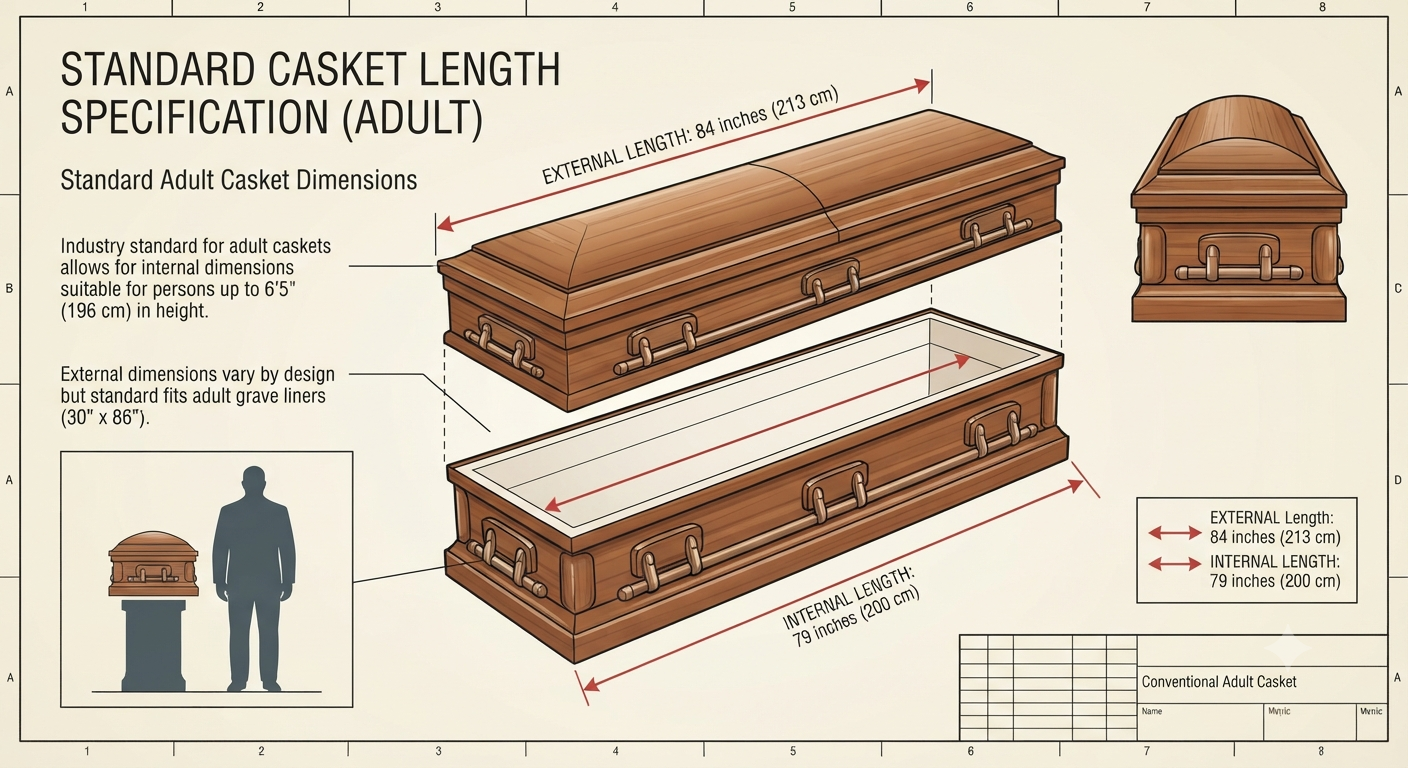
The standard casket length in the United States is generally about 84 inches, or 7 feet, measured on the outside. That figure is useful, but it does not tell the whole story: interior sleeping space is shorter, manufacturers vary, and the correct choice depends on body measurements, casket construction, burial-vault limits, and the requirements of the cemetery or crematory.
Most standard adult models are approximately 84 inches long, 28 inches wide, and 23 inches high externally. A commonly cited interior range is roughly 78 to 79 inches long and 23 to 24 inches wide, although upholstery, mattress thickness, shell shape, and lid design can change the usable space.
What Is the Standard Casket Length?
For an ordinary adult burial casket that is sold in the United States, the standard length is 84 inches or 213.4 centimeters. This refers to the length of the outside of the item. The length is measured specifically from the head end to the foot end of the casket’s exterior and does not include the size of the mattress.
The standard size 84 inches is common for both wood and metal caskets, but products of different brands may have a length that is lower or higher by an inch or two. Furthermore, manufacturers usually make enhanced-width and enhanced-length products, so standard size is a relative indicator of the casket’s dimensions.
Standard Exterior and Interior Measurements
The following exterior and interior measurements of a standard casket can serve as a reference point for size selection.
Exterior length: 84 inches or 213.4 cm
Exterior width: 28 inches or 71.1 cm
Exterior height: 23 inches or 58.4 cm
Interior length: 78-79 inches or 198.1-200.7 cm
Interior width: 23-24 inches or 58.4-61 cm
Interior depth: 14 inches on average, but highly varies depending on the model
Therefore, it is impossible to select a casket based on the height of the deceased due to the significant difference between the exterior and interior length of the product. Several elements of the casket, such as the shell, end pieces, mattress, pillows, and mechanical parts of the bed, reduce the interior size of the product.
Why Exterior Length and Interior Length Are Different
The exterior dimension tells the funeral home, cemetery, transporter, or crematory how much physical space the casket occupies. The interior dimension tells the funeral director how much usable room is available for positioning the deceased.
That difference matters when interpreting the standard casket length. An 84-inch casket may provide only about 79 inches of internal length, and the effective space can be reduced further by a thick pillow, raised mattress, rounded ends, or decorative upholstery.
Construction Changes the Usable Space
Two caskets with the same exterior size can fit differently. A thick solid-wood shell may provide less internal room than a thinner metal shell, while swing-bar handles, decorative corners, and hardware can increase the total exterior footprint without increasing the bed area.
The standard casket length is therefore only the first number to request. Ask for the manufacturer’s exact interior length, interior width, interior depth, exterior width with handles, and rated load capacity before approving a model.
Will a Standard Casket Fit a Tall Person?
The standard casket length can accommodate many tall adults, but standing height alone does not answer the question. Funeral directors position the body lying down, typically with the head supported and the knees or feet arranged naturally, so the required internal length does not always equal the person’s full standing height.
A person close to the interior limit may still fit comfortably in a standard model. Someone shorter, however, may need more width or depth because of shoulder breadth, body shape, medical conditions, swelling, clothing, or the desired viewing presentation.
The responsible approach is to let the funeral director assess actual measurements. Height or weight alone should not be used as a shortcut for choosing a casket.
When Extra Length May Be Necessary
An extended-length casket may be appropriate when:
- The deceased is exceptionally tall and the interior bed is too short.
- The selected model has heavily padded ends or a thick mattress.
- Natural, dignified positioning cannot be achieved without compression.
- Religious clothing, uniforms, footwear, or personal items require extra space.
- The funeral home recommends a longer shell after measuring the body.
Do not assume that an “oversize” casket is automatically longer. Many oversize products are designed mainly to provide extra width, and some remain close to the standard casket length externally.
Standard Casket Length Versus Oversize Casket Dimensions
Oversize caskets may add width, length, structural reinforcement, or all three. Matthews Aurora states that it offers metal caskets in enhanced widths and lengths, while Batesville markets dedicated oversize lines for larger individuals.
Even when the standard casket length remains unchanged, width is often the dimension that triggers additional planning. Batesville notes that many standard burial vaults can accommodate caskets with up to 28 inches of interior width, but identifies 29.5 inches of exterior width as a key vault threshold.
Exceeding that threshold may require an oversize vault or generate additional cemetery charges. Exact policies and fees should be confirmed directly with the cemetery.
Common Oversize Planning Issues
Moving beyond the standard casket length or width can affect more than the casket price. The family and funeral provider may need to confirm:
- Availability of an oversize burial vault or grave liner
- Grave-space width and cemetery opening fees
- Mausoleum crypt dimensions
- Hearse, church doorway, elevator, and chapel access
- Crematory door, charging bier, and chamber limits
- The number of trained personnel and equipment needed for safe handling
A newer design does not always require an oversize vault. In 2025, Batesville announced wood caskets offering 28 inches of interior width while still fitting a standard vault, showing why exact model specifications matter more than a broad “standard” or “oversize” label.
Does the Standard Casket Length Fit Every Burial Vault?
No. A vault must be matched to the casket’s full exterior measurements, not merely its advertised category or stated standard casket length.
Handles, corners, shell shape, and decorative hardware can influence clearance even when the basic length and width appear acceptable. Small dimensional differences may become important once the casket is lowered into a rigid concrete, metal, or composite vault.
Before purchase, ask the funeral home or cemetery to confirm the maximum inside dimensions of the vault and the maximum permitted casket dimensions. This check is especially important when buying online, selecting an enhanced-width model, or arranging burial in an older family plot.
Cemetery Rules Can Add Another Layer
No U.S. state law universally requires an outer burial container, but many cemeteries require a grave liner or vault to help prevent the grave from settling. Under the FTC Funeral Rule, consumers are entitled to see an outer burial container price list and receive an explanation of any legal, cemetery, or crematory requirement that adds a cost.
The standard casket length may fit the grave itself but still conflict with a particular vault, crypt, or cemetery operating policy. Written confirmation prevents expensive substitutions or delays on the day of the service.
Standard Casket Length for Cremation
A burial casket and a cremation container serve different practical purposes. Some families choose a ceremonial cremation casket, but U.S. law does not require a traditional casket for direct cremation.
Funeral homes that offer cremation must tell consumers that alternative containers are available and make those containers available. Depending on the provider, an alternative container may be constructed from unfinished wood, fiberboard, pressed wood, or cardboard.
When a casket will enter a cremation chamber, the relevant question is not simply whether it matches the standard casket length. The crematory must approve the complete outside dimensions, total weight, construction materials, hardware, and combustible components.
Confirm These Crematory Specifications
Ask for written confirmation of:
- Maximum container length, width, and height
- Maximum combined weight of the deceased and container
- Permitted construction materials and finishes
- Whether handles or decorative fittings must be removed
- Whether metal components are allowed
- Whether a viewing casket can be rented
- Whether an alternative container will be used for the actual cremation
Crematory equipment varies from one facility to another. A casket accepted by one crematory may not meet the operational limits of another, even when both facilities serve the same geographic area.
The funeral director should coordinate approval before a third-party casket is shipped. This is particularly important for oversize, highly decorated, metal, or imported products.
Casket, Coffin, and Regional Size Differences
“Casket” and “coffin” are often used interchangeably in casual speech, but the products may differ in shape. A casket is usually rectangular with a hinged lid, while a traditional coffin is tapered around the shoulders and feet.
That geometry changes how exterior and interior measurements are interpreted. A tapered coffin may have adequate shoulder width but considerably less room near the feet than a rectangular casket with similar maximum dimensions.
The standard casket length discussed in this guide reflects common U.S. adult casket dimensions. Standards differ internationally: St. Peter Life Plan in the Philippines, for example, describes its standard size as approximately 180 centimeters long and 60 centimeters wide, which is smaller than the common U.S. exterior benchmark.
This regional variation is important for repatriation, international shipping, and funerals involving imported products. Never convert a local “standard” label into a U.S. assumption without obtaining a complete dimension sheet.
How to Measure and Choose the Correct Casket Size
Families should not be expected to measure the deceased themselves or decide fit from the standard casket length alone. The funeral director or trained mortuary staff should assess the body, evaluate positioning, and identify models that provide dignified clearance.
The assessment may include height, shoulder width, hip width, body depth, physical condition, clothing, and the intended presentation. A viewing with the upper half of the casket open may create different positioning considerations from a closed-casket burial.
Use the standard casket length as a starting point, then follow a structured verification process.
1. Confirm the Required Body Dimensions
The funeral director should consider overall height, shoulder width, hip width, body depth, medical conditions, clothing, and viewing plans. Ask whether the selected casket provides adequate room without compressed or unnatural positioning.
2. Request the Interior Specification Sheet
Obtain the actual usable length, width, and depth—not only the exterior dimensions printed on a retail listing. Confirm whether the measurements account for installed padding, pillows, mattress height, and interior mechanisms.
3. Check Every Facility Clearance
Verify the burial vault, grave, mausoleum crypt, hearse, chapel entrance, church doorway, elevator, and crematory limits. For larger models, confirm turning space as well as doorway width.
4. Confirm Delivery Timing
For a third-party purchase, coordinate model approval and delivery directly with the funeral home. Ask when the product must arrive, who will inspect it, and what happens if the casket is delayed, damaged, or incorrectly sized.
5. Get Additional Costs in Writing
Ask about oversize vaults, wider grave openings, cemetery fees, special transportation, extra personnel, equipment, and delivery charges. These expenses may not be included in the casket’s advertised price.
This process is more reliable than choosing by height, weight, or a website’s generic size chart. It also gives the family a documented record if the product description and delivered dimensions do not match.
Buying a Casket Online: Size and Consumer Rights
U.S. consumers may purchase a casket from a third-party seller and have it delivered to the funeral home. The FTC states that a funeral provider cannot refuse to use an externally purchased casket or charge a fee simply because it was bought somewhere else.
That right does not remove the need for dimensional approval. Before ordering, send the manufacturer’s product sheet to the funeral director and request written confirmation that the casket, vault, cemetery, and final-disposition facility are compatible.
Do not rely solely on photographs or a product title containing the word “standard.” The stated standard casket length must be supported by complete interior and exterior measurements.
Questions to Ask Before Paying
Use these questions to reduce last-minute problems:
- Is the listed standard casket length an exterior or interior measurement?
- What is the exact usable bed length after padding is installed?
- Does the stated width include handles and decorative hardware?
- Will the model fit the selected vault, crypt, grave, or crematory?
- Is the casket rated for the required combined load?
- Who is responsible if the delivered model is damaged or incorrectly sized?
- Are oversize delivery, vault, staffing, or cemetery fees itemized?
- Can the seller provide a manufacturer-issued specification sheet?
- What is the cancellation or return policy after shipment?
The FTC also gives consumers the right to receive price information, review a written casket price list before seeing caskets, and obtain an itemized statement of selected goods and services. These protections make it easier to compare dimensions and costs without accepting an unwanted package.
Mistakes to Avoid When Comparing Casket Dimensions
The most common mistake is treating the exterior measurement as usable body space. A second is assuming every product described as “standard” has identical specifications.
Avoid these errors:
- Ordering from exterior length alone
- Using body weight as the only sizing factor
- Assuming oversize means both longer and wider
- Ignoring handles when checking doors or vault clearance
- Forgetting mattress and pillow thickness
- Failing to verify crematory or mausoleum limits
- Comparing measurements from different points on two products
- Accepting verbal assurances instead of written dimensions
- Purchasing before the funeral director approves the model
The standard casket length is helpful for initial planning, but a manufacturer’s model-specific specification sheet should control the final decision.
Frequently Asked Questions
What is the standard length of an adult casket?
The common U.S. exterior benchmark is about 84 inches, or 7 feet. The interior is usually shorter—often around 78 to 79 inches—because the shell, lining, padding, mattress, and end panels occupy space.
Always confirm whether a seller is quoting exterior or interior measurements. The distinction can represent several inches of usable space.
Can a 6-foot-6-inch person fit in a standard casket?
Possibly, but the answer depends on the model’s usable interior, the person’s body proportions, positioning, clothing, and physical condition. A funeral director should measure and assess the deceased rather than relying solely on standing height.
Some standard models may provide adequate room, while others may not. A slightly longer or differently constructed casket may be recommended when dignified positioning cannot be achieved.
Are wood and metal caskets the same length?
Many standard wood and metal models share an exterior length near 84 inches. Their interior measurements can differ, however, because wood thickness, metal shell construction, padding, hardware, and end-panel design affect usable space.
Request the exact specification sheet for the selected model. Do not assume that equal exterior measurements produce equal interior capacity.
How long is an oversize casket?
There is no single oversize length. Some models add only width, while others provide enhanced length, depth, structural reinforcement, or a combination of these features.
The term “oversize” is therefore not enough to determine compatibility. Ask for complete internal and external dimensions, including handles and decorative projections.
Does a standard casket fit in every grave or crematory?
No. A standard grave may still require a compatible vault, while a mausoleum crypt may have strict opening dimensions.
A crematory may also impose maximum length, width, height, weight, and material requirements. Confirm the exact casket model with the cemetery, vault provider, mausoleum, or crematory before purchase.
Final Takeaway
The standard casket length is generally 84 inches externally, with roughly 78 to 79 inches of internal length in many adult models. Treat that number as a starting benchmark—not a guarantee of fit.
Before approving or ordering a casket, ask the funeral director for the deceased’s required interior dimensions, obtain the model’s complete specification sheet, and secure written confirmation from the cemetery or crematory. That three-part check protects dignity, prevents costly last-minute changes, and gives the family confidence that every part of the arrangement will work as planned.
