
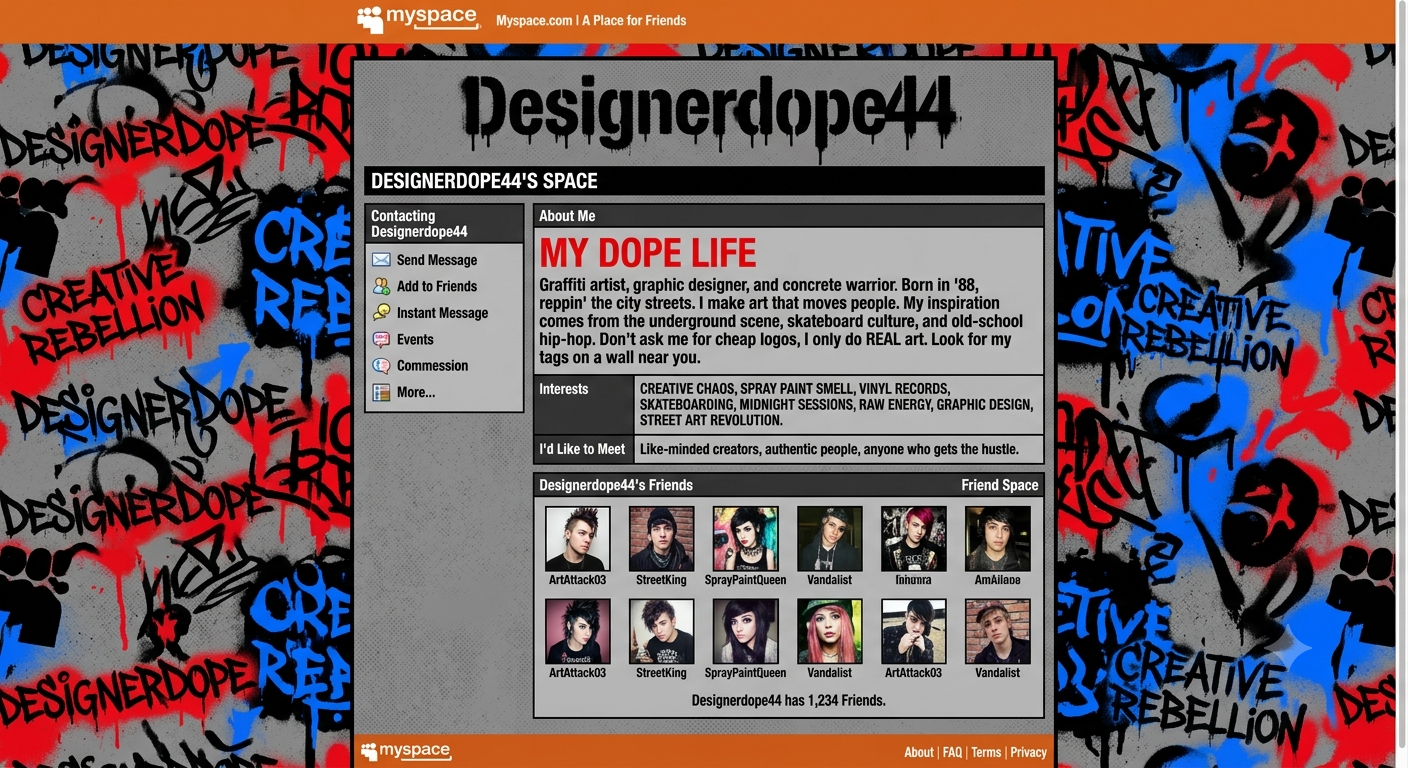
Designerdope44 Myspace is a search phrase linked to curiosity about an old Myspace username, profile, or digital identity from the platform’s peak years. The difficulty is that the available public evidence does not currently establish who owned the handle, what the original page contained, or whether a surviving profile can be reliably connected to it.
That distinction matters. Several recent articles treat the phrase as a symbol of early social-media culture, yet they provide no original profile URL, archived capture, owner verification, screenshots, or dated posts. A responsible explanation should therefore separate confirmed Myspace history from assumptions about one unverified username.
This article evaluates Designerdope44 Myspace as a research question rather than presenting it as a confirmed identity.
Quick Answer: What Is Designerdope44 Myspace?
The most accurate answer is that Designerdope44 Myspace appears to be an old-style username query associated with Myspace nostalgia. It may have referred to a personal profile, creative page, music account, fashion-related identity, or simply a handle remembered by someone searching the web.
What is publicly verifiable is limited:
- The phrase resembles a Myspace username-plus-platform search.
- Recent websites discuss it retrospectively, mainly as an example of 2000s online identity.
- No confirmed owner or authoritative biography is established in the sources reviewed.
- No primary archived page has been supplied by the articles currently ranking for the term.
- The number “44” cannot be decoded reliably without evidence from the original account owner.
This evidence-first approach gives readers something more useful than a fictional backstory: a clear picture of what is known, what remains uncertain, and how to investigate the handle properly.
Why Is Designerdope44 Myspace Being Searched?
Searches for Designerdope44 Myspace likely come from one of several intents. A former user may remember the handle. Someone may have seen it in an old screenshot, forum signature, message, playlist, or cached search result.
Another possibility is that the term has gained visibility because websites began publishing articles about it, creating a new layer of search interest around an older-sounding name.
That last point is important. Search results can make an obscure phrase look historically significant even when the available pages are recent and derivative.
In this case, the strongest ranking articles discuss the handle broadly but do not demonstrate that it belonged to a notable public figure, brand, musician, or documented internet personality.
The Username Structure Fits Early Social-Media Culture
The handle itself combines three familiar elements:
- “Designer” suggests fashion, visual creativity, styling, graphics, or aspirational branding.
- “Dope” was commonly used as slang for something impressive, stylish, or culturally current.
- “44” may have been added for availability, personal meaning, a jersey number, a date, or no special reason at all.
Those interpretations are plausible, but they remain interpretations. Treating them as confirmed facts would weaken trust and violate basic E-E-A-T principles.
What Myspace Profiles Were Like During the Platform’s Peak
To understand why Designerdope44 Myspace feels believable as an old handle, it helps to understand how Myspace worked. Profiles were not merely account pages.
They functioned like highly personal mini-websites where users mixed identity, friendship, music, images, and design.
Research on Myspace has examined how users disclosed personal information and constructed a “virtual self” through profile elements and social interaction. Other scholarship has explored how features such as the Top 8 turned friend ordering into a visible statement about relationships and community.
Customization Was Part of the Identity
Classic Myspace pages could look dramatically different from one another. Users changed backgrounds, typefaces, colors, images, embedded media, and layout elements.
That freedom created pages that were sometimes chaotic, slow, or difficult to read—but unmistakably personal.
A 2022 study of Myspace nostalgia describes how users remember profile customization as a form of informal front-end web development. That helps explain why old handles are remembered alongside specific color schemes, songs, graphics, and coded layouts rather than as plain account names.
For a handle such as Designerdope44 Myspace, the profile design may have been as meaningful as the username. A visitor might remember a glitter graphic, fashion image, embedded track, or dramatic background even after forgetting the person’s real name.
Music Was More Than Background Sound
Myspace was deeply connected to musicians, bands, fans, and local scenes. Academic work on the platform described music as “cultural glue” that helped artists form communities and communicate directly with audiences.
A profile song could communicate mood, genre loyalty, subculture, romance, humor, or status within seconds. If Designerdope44 Myspace was a genuine profile, its music selection may have revealed more about its identity than the short bio did.
Teen Users Were Active Creators
Pew Research documented how teenagers helped drive participatory online media by creating and sharing content, rather than only consuming it. Myspace belonged to that period when young users built profiles, posted photos, wrote blogs, shared music, and experimented with public self-presentation.
That creative environment is the strongest historical context for understanding the phrase. It does not prove who used the name, but it explains why a stylized handle could become a memorable digital artifact.
Is There a Verified Designerdope44 Myspace Profile?
At present, the available indexed evidence does not verify an original account page. The articles that discuss Designerdope44 Myspace do not provide the basic materials needed to authenticate a historical profile.
A credible verification would require at least one of the following:
- A live Myspace profile using the exact username
- A Wayback Machine capture showing the page
- An old external link pointing to the profile
- A screenshot with a visible URL and date context
- Cross-platform accounts linked by the original owner
- Contemporary forum, blog, music, or social references
- Direct confirmation from the person who controlled the account
Without one of those signals, the safest description is an unverified historical username query, not a documented personality or established brand.
How to Search for the Original Designerdope44 Myspace Page
Anyone researching Designerdope44 Myspace should follow a reproducible process rather than relying on recycled articles. The steps below improve the chances of finding genuine traces while reducing mistaken identity.
1. Test the Exact Username Format
Myspace’s own help documentation explains that the text appearing after myspace.com/ is the account username. That means the most obvious profile pattern would be the platform domain followed by the suspected handle.
A missing or broken page does not prove that the account never existed. The username may have changed, the profile may have been deleted, the page may not be indexed, or older content may no longer render correctly.
2. Search Myspace by Name, Email, and Alias
The current Myspace Help Center says users can search for people by name or email address. It also advises people looking for missing photos to search an old email address, full name, or alias because they may have more than one account.
This is particularly useful when the remembered username is incomplete. Variations such as “designerdope,” “designerdope44,” or a real-name alias may produce different results.
3. Search for Old External Mentions
Many Myspace profiles were linked from:
- Blogspot and WordPress blogs
- Tumblr pages
- Forum signatures
- Band websites
- Photo captions
- YouTube descriptions
- Event flyers
- Old email messages
- AIM, MSN, or Yahoo profile pages
Use quotation marks around the exact handle and combine it with words such as Myspace, profile, music, photos, blog, fashion, or a suspected location. Old links can reveal the original URL even when the destination no longer works.
4. Check Web Archives Carefully
The Wayback Machine may contain captures of a profile or websites that linked to it. However, web archives are incomplete.
Dynamic pages, private profiles, media files, scripts, and login-protected content were not always captured successfully.
A search result without an archived profile should therefore be treated as absence of evidence, not evidence that the account was invented.
5. Compare Cross-Platform Identity Signals
If the handle appears on another platform, compare only public, non-sensitive clues:
- Matching display names
- Reused profile images
- Similar biographies
- Shared location
- Links between accounts
- Repeated creative work
- Consistent dates
Do not identify a private individual from weak similarities. A matching username alone is not enough, especially when the phrase contains common words and numbers.
Why Old Myspace Content Can Be Difficult to Recover
The historical record surrounding Designerdope44 Myspace may be incomplete for reasons larger than one profile. Myspace confirmed that media uploaded before 2016 could be unavailable following a server migration.
Reporting at the time described the loss as affecting years of photos, audio, and video.
The Internet Archive later published the MySpace Dragon Hoard, a collection of approximately 490,000 MP3 files gathered from the platform between 2008 and 2010. That rescue preserved only a portion of the lost music ecosystem and does not function as a complete archive of personal profile pages.
Myspace’s help documentation also states that private messages sent before June 2013 are no longer available and cannot be retrieved.
These losses matter because an old profile was a network of connected evidence: messages, photos, comments, songs, friend links, blogs, and embeds. Once several layers disappear, confirming a username becomes much harder.
Can the Account Owner Recover the Profile?
Possibly. Myspace’s Help Center states that Classic profiles remain on the service and provides account-recovery guidance.
Users who remember the username can attempt a password reset. Those who no longer control the original email address can use the support request process.
For someone who actually owned Designerdope44 Myspace, the best recovery checklist is:
- Try every old email address associated with the period.
- Search saved password managers and browser records.
- Search old inboxes for Myspace registration or notification emails.
- Test the exact username in the password-reset flow.
- Gather the profile URL, old screenshots, and ownership evidence.
- Contact Myspace support through the official request form.
- Download or preserve any content that becomes accessible.
Recovery should be attempted only by the legitimate account owner. Guessing security information, impersonating another person, or trying to access an account without permission is inappropriate and potentially unlawful.
Privacy, Accuracy, and Responsible Research
An article about Designerdope44 Myspace should not transform a thin username trail into claims about a real person. Old social profiles may belong to private individuals who never expected their teenage pages to become subjects of modern search traffic.
Responsible researchers should:
- Avoid publishing private contact information
- Avoid guessing age, location, gender, or identity
- Avoid presenting username analysis as biography
- Blur sensitive details in screenshots
- Cite archived material with capture dates
- Label speculation clearly
- Remove information when ownership or consent concerns are credible
Myspace currently offers public and restricted profile settings, and its help pages explain that restricted profiles limit what non-approved users can see. That reinforces a basic principle: available information should not be treated as permission to expose someone’s identity.
What Existing Articles Miss About Designerdope44 Myspace
Most pages targeting this keyword focus on broad Myspace nostalgia. That approach is easy to write, but it leaves the reader’s main question unanswered: Was there a real, traceable account?
A stronger article adds information gain by doing four things:
- States the evidence gap immediately.
- Separates platform history from profile-specific claims.
- Provides a practical verification workflow.
- Explains why missing data does not settle the question.
This is the central takeaway. Designerdope44 Myspace may represent a real forgotten profile, a remembered alias, or a keyword amplified by recent content.
Until primary evidence emerges, no responsible publisher should claim more.
Why the Search Still Matters
Even an unverified handle can open a useful discussion about digital memory. Myspace profiles were early experiments in personal branding, page design, music curation, public friendship, and online identity.
Many users learned to manipulate code, organize visual media, and communicate with audiences long before those skills became standard parts of creator culture.
The search for Designerdope44 Myspace also reveals a weakness in the modern web: repetition can outrank verification. Once several sites repeat a speculative explanation, the explanation may begin to look established.
E-E-A-T requires the opposite approach—identify the original evidence, cite reliable sources, disclose uncertainty, and never invent missing details.
Conclusion: Treat the Phrase as a Research Lead, Not a Confirmed Biography
Designerdope44 Myspace should be regarded as unverified username-based research about the cultural phenomenon that was the social-media profile, its history and demise. The history of the Myspace account is well-documented – but the identity, contents, and ownership of this particular username is not confirmed by any of the publicly accessible sources detailed below.
The next logical step is to perform a search for the username, check possible profile urls, scan old emails and links, go through web archives, and verify each item before reporting it as fact.
Before any of these steps are taken, however, it’s important to retain a certain level of skepticism. After all, anyone can claim to be someone or something on the internet. Curiosity may be good, but so is healthy caution.
Frequently Asked Questions
What does Designerdope44 Myspace mean?
Designerdope44 Myspace most likely refers to a search for an old Myspace username or profile. The words may suggest design, fashion, creativity, or 2000s slang, while “44” may be personal or may simply have made the username available.
No interpretation has been confirmed by an original owner or primary profile record.
Was Designerdope44 a famous Myspace user?
There is no reliable public evidence in the sources reviewed showing that the handle belonged to a celebrity, well-known artist, influencer, or major brand.
Articles describing it as culturally meaningful discuss the broader Myspace era rather than documenting a notable account owner.
Can an old Myspace profile still be found?
Sometimes. Myspace says Classic profiles remain on the platform, and its Help Center provides search and account-recovery options.
Results depend on whether the account still exists, whether the username changed, whether the profile is restricted, and whether its content survived platform migrations.
Can deleted Myspace photos, songs, or messages be recovered?
Recovery is inconsistent. Some account content may remain, but Myspace reported major losses affecting older media, and its Help Center says private messages sent before June 2013 cannot be retrieved.
Web archives, personal backups, old computers, email attachments, and external photo hosts may contain surviving copies.
How can I verify that a profile really belonged to someone?
Use multiple independent signals: an archived page, a dated external link, a matching profile image, connected official accounts, consistent biographical details, or direct confirmation from the owner.
Never rely on the username alone, and do not publish private identity claims without strong evidence.
