
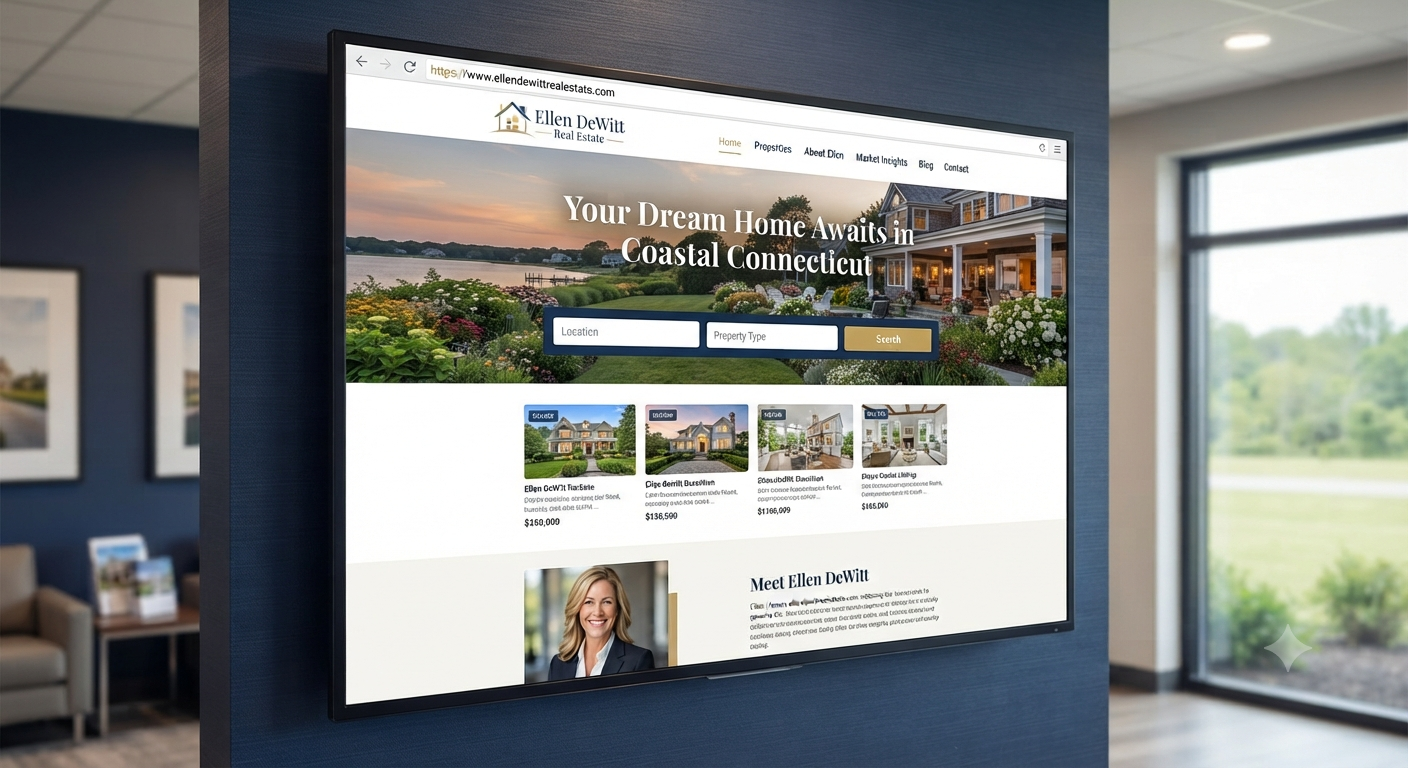
Ellendewittrealestate.com is easy to misunderstand at first glance. The domain carries the name of a real estate business with roots in Milo, Maine, yet the website visible today operates mainly as a broad property, finance, renovation, and home-living publication, not as a conventional listing portal.
That difference matters. A buyer searching for active Maine homes needs different tools from a reader researching rental yield, home security, mortgage strategy, construction materials, or interior design.
This guide explains what the site currently contains, where its name comes from, how useful its articles may be, and which claims readers should independently verify before making financial or legal decisions.
What Is Ellendewittrealestate.com Today?
The current version of Ellendewittrealestate.com is an editorial website covering much more than property sales. Its navigation includes real estate, buying and selling, agents, construction, finance, mortgages, insurance, investing, home security, outdoor spaces, furniture, kitchens, bedrooms, bathrooms, dining rooms, and decorating ideas.
Recent posts show an international focus. The homepage has published material about UK coliving, US short-term rentals, French property investment, British crowdfunding, energy-efficient renovation, and comparisons between American and British housing systems.
That editorial range makes the site closer to a general real estate knowledge hub than a local brokerage website.
For this reason, Ellendewittrealestate.com works best as a research starting point, not as a substitute for a listing database or professional consultation.
Visitors should approach the domain with the right expectations:
- Use it to discover terminology, questions, risks, and possible strategies.
- Do not assume every article applies to your country, state, tax position, or tenancy rules.
- Confirm financial figures, regulations, incentives, and deadlines through primary sources.
- Use an active listing service or licensed local agent when searching for property.
- Compare high-stakes advice with official government and regulatory websites.
This distinction also helps explain why some online descriptions of the website are inaccurate. Several third-party pages describe advanced property search tools, luxury listings, valuation features, or personalized brokerage services, but those features are not prominent on the current site itself.
Direct inspection should carry more weight than promotional descriptions or recycled claims published elsewhere.
The Historical Connection Behind the Domain Name
The name is not random. Ellen DeWitt was associated with a long-running real estate business in Milo, Maine, and historical property records still reference the former website in old listing descriptions.
Zillow identifies Ellen DeWitt as a broker connected with DeWitt-Jones Realty and records more than 100 historical sales. Older listing pages also link the domain to Ellen DeWitt Real Estate.
Local reporting provides a clearer timeline. Donna Jones took over the business in 2011 as Ellen and Edwin DeWitt moved toward retirement.
The firm, formerly called Ellen DeWitt Real Estate, became DeWitt-Jones Realty, preserving the DeWitt name because it was already familiar within the local community.
Today, the active brokerage presence appears to be DeWitt-Jones Realty rather than Ellendewittrealestate.com. Its separate website displays property-search sections, recent listings, buyer and seller services, agent information, testimonials, an office address, and an IDX disclosure for Maine listings.
The brokerage states that it serves Milo and other communities across Central and Eastern Maine.
Why This History Matters to Users
A legacy domain can retain recognition long after the business attached to it changes direction, ownership, or purpose. Search engines may also continue showing old property descriptions that mention the former brand and URL.
As a result, readers can encounter two different identities:
- The historical identity: A Maine real estate brokerage associated with Ellen DeWitt.
- The current website identity: An internationally oriented home and property information publication.
Treating those identities as interchangeable can create confusion.
Someone seeking current Maine listings should visit the active brokerage website or a recognized MLS-connected portal. Someone looking for educational articles may find useful introductory material on Ellendewittrealestate.com.
What Topics Does Ellendewittrealestate.com Cover?
The website’s main appeal is its breadth: it covers a wide range of topics related to the property cycle, from financing and valuation to maintenance, renovation, furnishing, protection, letting, and selling.
Buying, Selling, and Property Decisions
The buying-and-selling section covers transaction processes, online real estate platforms, market conditions, sale durations, buyer profiles, investment locations, and housing access.
These topics can help the reader understand the ins and outs of the process before consulting an agent, mortgage broker, surveyor, conveyancer, inspector, or notary.
The most interesting articles on Ellendewittrealestate.com are those that delve into the subject matter, providing valuable insights beyond a superficial overview. A buyer may want to learn about the implications of a property’s energy rating or the factors that make a rental property a good investment. They may also be interested in learning how different digital platforms operate or the differences in transaction processes in various countries. However, it is crucial to recognize that location-specific legal details may differ significantly.
A buyer may not know which specific disclosure laws apply to a property in France or how closing procedures work in Maine. Similarly, a mortgage broker in the United States may not know the intricacies of the British property market. In other words, the website is a great tool for research, but it should not replace location-specific due diligence.
Finance, Mortgages, and Property Investing
Finance content includes rental yield, vacancy risk, crowdfunding, taxation, mortgage costs, portfolio structure, inflation, and investment diversification.
One portfolio article, for example, discusses gross versus net yield, energy-performance audits, refinancing, liquidity reserves, tax structures, and the risks of retaining an underperforming asset.
This kind of framework can be valuable because it pushes readers beyond headline returns.
A property generating attractive gross rent may deliver a weak net result after accounting for:
- Vacancy periods
- Property-management fees
- Mortgage interest
- Repairs and maintenance
- Insurance premiums
- Local and national taxes
- Utility responsibilities
- Compliance costs
- Legal and accounting expenses
- Selling and exit costs
The limitation is equally important. Some articles include forecasts, percentage ranges, legal frameworks, and tax observations without providing a full bibliography or direct links beside every claim.
Readers should verify those details through tax authorities, central banks, government housing agencies, official statistics bodies, and qualified professionals.
Understanding Gross and Net Rental Yield
Gross rental yield measures annual rental income against the property’s purchase price. It can provide a quick comparison between properties, but it does not show the complete financial picture.
Net yield deducts operating expenses from rental income before comparing the result with the total investment. A realistic calculation may also include acquisition taxes, renovation costs, furnishing, financing fees, and an emergency reserve.
Consider a simplified example. A property bought for $200,000 and rented for $18,000 per year has a 9% gross yield.
If expenses consume $8,000, the remaining $10,000 produces a 5% yield before income tax and major capital expenditure. That is a very different investment outcome.
This is why readers should use educational articles to identify calculations, then apply those calculations to their own numbers.
Renovation, Construction, and Energy Efficiency
The construction section covers building systems, renovation techniques, materials, and energy performance. Homeowners can use these articles to create a more informed question list before requesting contractor estimates.
When reading Ellendewittrealestate.com for renovation guidance, practical research should go further. Check local building codes, permit requirements, product certifications, warranties, fire ratings, moisture performance, climate suitability, labor costs, and maintenance needs.
A material that performs well in one region may fail quickly in another because of:
- Extreme heat
- Freeze-thaw cycles
- High humidity
- Coastal salt exposure
- Heavy rainfall
- Poor ventilation
- Incorrect installation
Energy-efficiency upgrades deserve similar scrutiny. New windows, insulation, heat pumps, solar panels, and smart controls may reduce operating costs, but the financial return depends on the building, climate, energy prices, installation quality, and available incentives.
Never rely on a generalized savings percentage without calculating the likely outcome for the specific property.
Interiors, Security, and Outdoor Living
Ellendewittrealestate.com also publishes lifestyle content about kitchens, bathrooms, bedrooms, furniture, décor, home security, and outdoor spaces.
This broadens its audience beyond investors and active buyers. Existing homeowners, tenants, renovators, and design enthusiasts may also find relevant ideas.
These sections are best used for inspiration and preliminary planning. Readers can compare layouts, create renovation priorities, identify safety upgrades, and consider how design choices may affect usability or resale appeal.
Product-specific or structural decisions require more than online inspiration. Measurements, professional assessment, material samples, installation requirements, and realistic cost estimates should shape the final choice.
How Reliable and Transparent Is the Website?
A useful way to assess Ellendewittrealestate.com is to avoid a simplistic “trusted” or “untrusted” verdict. Trust is not a simple yes-or-no label.
A better evaluation separates usefulness, editorial transparency, source quality, and decision risk.
Positive Signals
The site uses clear topical categories and publishes substantial articles rather than thin one-paragraph pages. Many pieces discuss genuine decision factors such as cash flow, regulation, maintenance, energy performance, financing, vacancy, and professional advice.
Its recent publishing activity is also visible. As of July 2026, the homepage shows frequent additions across housing, investing, construction, and home-improvement topics.
The broad category structure helps users move from one part of a property decision to another. An investor researching rental returns can also explore insurance, renovation, taxation, home security, and selling strategies.
That interconnected coverage is useful because property decisions rarely happen in isolation.
Signals That Require Caution
The main navigation does not prominently surface a detailed About page, editorial policy, corrections policy, or author-credential page.
The contact page provides a basic email instruction but displays little visible organizational information in the parsed version of the page.
Articles are attributed to “Ellen Dewitt,” yet the current site does not clearly explain whether that name identifies the historical broker, an editorial account, or another contributor.
Because the site’s present ownership and editorial process are not clearly established on the pages reviewed, readers should avoid making assumptions.
The publication also spans France, the United Kingdom, and the United States. International coverage can be useful, but it increases the need for precise jurisdiction labels, current citations, and expert review.
That is particularly important for Your Money or Your Life topics, including:
- Mortgages
- Real estate taxation
- Insurance
- Landlord obligations
- Tenant rights
- Property investment
- Retirement planning
- Legal ownership structures
- Rental-income forecasts
An inaccurate decorating suggestion might waste a small amount of money. An outdated tax or mortgage claim could cause a much larger financial problem.
A Practical E-E-A-T Test for Ellendewittrealestate.com Articles
Google uses E-E-A-T to describe signals associated with experience, expertise, authoritativeness, and trustworthiness. Google also explains that trust is especially important and that people-first content should be accurate, useful, and created to benefit readers.
The framework becomes more useful when converted into a reader checklist.
1. Experience: Does the Article Show Real-World Understanding?
Look for operational detail. Strong property content explains hidden costs, timing problems, contractor risk, financing friction, tenant turnover, document requirements, and trade-offs between competing strategies.
Generic claims such as “real estate always appreciates” are weak. Detailed explanations of why an asset could underperform are more credible.
A useful article should acknowledge that results vary. It should not present one property type, location, financing structure, or renovation strategy as universally suitable.
2. Expertise: Is the Author Qualified for the Topic?
A décor article and a tax article should not carry the same evidentiary burden.
For legal, tax, mortgage, structural, or insurance guidance, look for:
- Relevant professional qualifications
- Clear author biographies
- Expert review
- Named sources
- Publication and update dates
- Jurisdictional limitations
- Disclosures of commercial relationships
When those elements are missing, treat the content as an overview rather than individualized advice.
3. Authoritativeness: Are Primary Sources Used?
Reliable property research should connect readers to land registries, government departments, tax agencies, central banks, planning authorities, building-code bodies, and recognized market datasets.
A named institution without a direct supporting source is not always sufficient. Search for the original publication and confirm its date, scope, methodology, and geographical coverage.
A national average may not reflect conditions in a small town, rural county, resort market, or expensive urban neighborhood.
4. Trust: Can You Understand Who Published It and Why?
Check for ownership information, author biographies, contact details, editorial standards, corrections procedures, privacy terms, and disclosure of commercial relationships.
The more consequential the advice, the more transparency readers should expect.
Ellendewittrealestate.com offers useful topic discovery, but its limited visible editorial information means readers should add an independent verification step before relying on high-stakes claims.
How to Use Ellendewittrealestate.com Safely and Productively
The smartest approach is not to accept or reject the entire website. Ellendewittrealestate.com can be productive when every important claim passes through a repeatable research workflow.
Step 1: Identify the Core Claim
Determine exactly what the article is recommending or predicting.
Is it discussing a mortgage rate, tax rule, renovation grant, investment location, legal structure, rental yield, or construction method? Write the central claim in one clear sentence.
Step 2: Confirm the Jurisdiction
Check whether the article refers to the United States, United Kingdom, France, or another market.
Within the US, state and municipal rules can differ dramatically. Within the UK, certain property rules and transaction systems vary between England, Wales, Scotland, and Northern Ireland.
Step 3: Separate Principles From Changing Facts
Some ideas are relatively stable. Maintaining an emergency repair fund, inspecting a property, comparing loan terms, and calculating net yield are sensible general principles.
Other information changes quickly. Interest rates, tax allowances, renovation incentives, landlord rules, registration requirements, and lending standards require current verification.
Step 4: Open Primary Sources
Verify government rules, statistical claims, market figures, and product standards independently.
The appropriate source may include:
- A tax authority
- Central bank
- Local planning department
- National statistics agency
- Land registry
- Housing ministry
- Financial regulator
- Building-code authority
- Licensed professional body
Step 5: Run Your Own Numbers
Calculate the likely outcome rather than relying on a national average.
Include purchase costs, financing, insurance, repairs, management, vacancies, taxes, compliance work, utilities, and selling expenses. Test both optimistic and conservative scenarios.
Step 6: Consult the Right Professional
Use a licensed agent, attorney, accountant, surveyor, inspector, lender, contractor, or insurance adviser when the decision carries material risk.
No general article can assess a reader’s complete financial position, local law, building condition, or contractual obligations.
Step 7: Record the Verification Date
Property information becomes stale. Record when you checked each regulation, rate, price, incentive, or market figure.
This step is especially important when planning a transaction that may take several months to complete.
Who Will Find the Website Most Useful?
The strongest use case for Ellendewittrealestate.com is helping readers define a question before they spend money or contact a professional.
Ellendewittrealestate.com is best suited to readers who are still exploring a topic. New buyers can learn the vocabulary of transactions, landlords can identify operating risks, and homeowners can investigate renovation or design ideas.
Investors may also use the site to build a due-diligence checklist before performing more detailed financial analysis.
It is less suitable for users who need:
- Live property inventory
- Confirmed agent availability
- A legally definitive answer
- Personalized mortgage advice
- Individual tax planning
- A professional property valuation
- A verified contractor recommendation
- Guaranteed investment returns
For current Central or Eastern Maine listings, DeWitt-Jones Realty presents the clearer active brokerage interface. Its website includes listing categories, buyer and seller services, recent properties, local contact information, and an IDX disclosure.
Common Mistakes to Avoid When Using Property Advice Websites
One common mistake is applying national data to a local deal. A national house-price trend may have little relevance to a property in a small rural market with limited inventory.
Another mistake is calculating only gross rental income. Investors who ignore repairs, vacancies, management charges, insurance, taxes, and financing can significantly overestimate returns.
Readers should also avoid treating forecasts as guarantees. Property prices, mortgage rates, construction costs, and rental demand depend on economic conditions that no publisher can predict with certainty.
Finally, never assume that an article’s publication date proves that every source inside it is current. A newly published page can still rely on old data, expired incentives, or rules that have already changed.
Frequently Asked Questions
Is Ellendewittrealestate.com a property-listing website?
The present website appears primarily to be an editorial publication rather than a full property-listing platform.
Its visible navigation centers on real estate education, finance, construction, investing, insurance, décor, security, and room-by-room home content. Readers looking for active Maine inventory should use an MLS-connected service or the separate DeWitt-Jones Realty website.
Is Ellendewittrealestate.com connected to Ellen DeWitt Real Estate in Maine?
The domain has a historical association with the former Ellen DeWitt Real Estate business.
Local reporting states that Donna Jones took over the company in 2011 and that it became DeWitt-Jones Realty while retaining the DeWitt name. The current editorial website and the active brokerage website should not automatically be treated as the same operation.
Can I trust the financial and investment articles?
Use them for orientation, terminology, and checklist building, but independently verify rates, forecasts, tax rules, legal claims, and return estimates.
Financial outcomes depend on location, financing, property condition, regulation, vacancy, expenses, and the reader’s individual tax position. High-stakes decisions should be reviewed by a suitably qualified professional.
Does the website cover only US real estate?
No. The current archive includes material concerning the United States, United Kingdom, and France, together with broader home-improvement and interior-design subjects.
Always check the country and legal context before applying a recommendation. Rules that appear similar can have materially different definitions, deadlines, and enforcement systems.
What should I verify before following its advice?
Confirm the article’s publication date, author credentials, jurisdiction, supporting data, current law, and whether the recommendation fits your property and financial position.
For high-stakes decisions, compare the article with official primary sources and obtain advice from an appropriately licensed local professional.
Final Verdict: Use the Site as a Starting Point, Not the Final Authority
Ellendewittrealestate.com has genuine value as a broad discovery resource. Its coverage can help readers understand unfamiliar terms, uncover risks they had not considered, and prepare better questions about buying, selling, investing, financing, renovating, securing, or improving a property.
Its name, however, carries a historical brokerage association that can create the wrong expectation. The current website is better understood as a property-information publication, while DeWitt-Jones Realty maintains the clearer active real estate service and listing presence in Maine.
Your next step should be practical. Choose the article relevant to your goal, extract its main claims, verify each time-sensitive fact through primary sources, and take your calculations or documents to a qualified local professional.
That approach preserves the educational value of Ellendewittrealestate.com without exposing an important property decision to avoidable uncertainty.
