
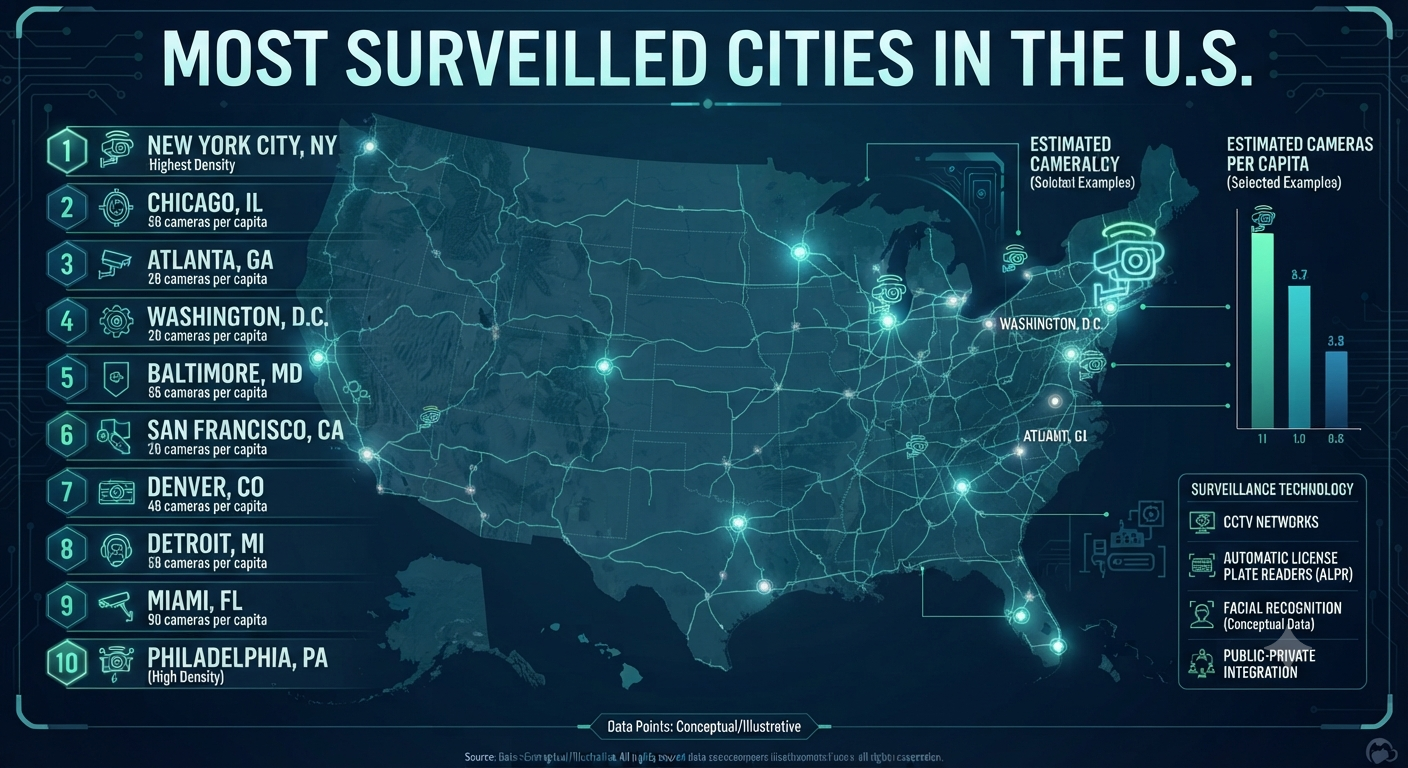
The most surveilled cities in the US are not always the largest cities or the places with the highest populations. Surveillance levels depend on many factors, including the number of public cameras, private security networks, police technology, transportation systems, and how many cameras exist compared with the number of residents.
Modern American cities use surveillance systems for many reasons. Law enforcement agencies use cameras to investigate crimes, monitor traffic, improve emergency response, and collect evidence. Businesses, transportation authorities, and private property owners also contribute thousands of additional cameras to the overall surveillance landscape.
Cities such as Atlanta, Washington, DC, Chicago, New York City, and Philadelphia have some of the most extensive surveillance networks in the country. However, measuring surveillance is complicated because there is no single national database that tracks every camera installed across public and private spaces.
Understanding the most surveilled cities in the US requires looking beyond simple camera counts. The type of technology, how data is stored, who can access it, and whether artificial intelligence is involved all play a major role in determining how monitored a city really is.
What Are the Most Surveilled Cities in the US?
Several American cities stand out because of their high concentration of surveillance cameras and advanced monitoring systems.
Based on available research comparing major US cities, the following locations are among the most heavily monitored:
- Atlanta, Georgia
- Washington, DC
- Philadelphia, Pennsylvania
- San Francisco, California
- Denver, Colorado
- Chicago, Illinois
- Detroit, Michigan
- Las Vegas, Nevada
- Memphis, Tennessee
- New York City, New York
Each city has developed its surveillance network differently. Some rely heavily on police-operated cameras, while others depend on partnerships between government agencies, transportation systems, and private businesses.
Atlanta: The Most Surveilled City in the US by Cameras Per Resident
Atlanta ranks highest in the United States in regards to the number of surveillance per person. It has one of the most extensive interconnected camera systems in the country. Atlanta is interconnected through a program that consists of the following:
Police
Traffic
Private
Business camera partnerships
Real crime monitoring
This system was created in the city due to a need for more effective ways of collecting video evidence. An important factor in this system is the city’s sharing of cameras with private businesses and organizations. This has allowed law enforcement to gather enough materials to convict many criminals.
Why Atlanta Has So Many Cameras
Several factors contribute to Atlanta’s high surveillance level:
- A strong focus on technology-based policing
- Large business districts with private cameras
- Heavy traffic and transportation monitoring
- Expansion of real-time crime centers
However, having more cameras does not automatically mean a city is safer. The effectiveness depends on how the technology is used and whether it improves emergency response and investigations.
Washington, DC: One of America’s Most Camera-Dense Cities
Washington, DC has one of the highest concentrations of surveillance cameras in the country.
The city’s unique role as the US capital contributes to its extensive monitoring infrastructure. Government buildings, public spaces, transportation systems, and security zones require advanced surveillance capabilities.
Surveillance Systems in Washington, DC Include:
- Public safety cameras
- Metro transportation cameras
- Traffic monitoring systems
- Federal security cameras
- Private security networks
Because of its high concentration of important government locations, Washington, DC has developed one of the most advanced urban surveillance environments in America.
The city also operates programs that allow police to identify nearby private cameras that may contain useful evidence.
New York City: The Largest Surveillance Network by Total Cameras
New York City has one of the largest surveillance networks in the world.
Although it may not rank highest when measured by cameras per resident, the city has an enormous number of cameras because of its size, population, and dense urban environment.
New York’s surveillance system includes:
- Subway cameras
- Street cameras
- Business security cameras
- Police cameras
- License plate readers
- Private building cameras
Why New York Uses Extensive Surveillance
New York relies on surveillance technology for:
- Crime investigations
- Counterterrorism efforts
- Traffic management
- Public transportation security
- Emergency response
The city’s massive population means millions of people pass through monitored areas every day.
Chicago: A Leader in Real-Time Crime Monitoring
Chicago has developed one of the largest urban surveillance systems in the United States.
The city operates a connected network that combines thousands of cameras with emergency response systems.
Chicago Surveillance Technology Includes:
- Police observation cameras
- Gunshot detection systems
- License plate readers
- Transportation cameras
- Private camera partnerships
Chicago’s approach focuses heavily on real-time information. Instead of simply recording footage, the goal is to help authorities respond faster during active incidents.
Philadelphia: Growing Public and Private Camera Networks
Philadelphia is another city with a significant surveillance presence.
The city uses camera registration programs that help investigators locate possible video evidence after crimes occur.
Important surveillance sources include:
- Public street cameras
- Business security cameras
- Transportation cameras
- Police monitoring systems
The growth of private camera partnerships has changed how cities collect evidence. Police departments no longer depend only on government-owned cameras.
How Surveillance Technology Works in US Cities
The most surveilled cities in the US use many different technologies rather than relying only on traditional CCTV cameras.
Closed-Circuit Television (CCTV)
CCTV cameras remain the foundation of urban surveillance.
They are commonly installed in:
- Streets
- Parking areas
- Public buildings
- Transportation stations
- Commercial districts
These cameras usually record video that can be reviewed later during investigations.
Automated License Plate Readers (ALPR)
Automated License Plate Readers capture vehicle information, including:
- License plate numbers
- Location
- Time of travel
- Vehicle details
Police departments use ALPR systems to locate stolen vehicles, investigate crimes, and identify vehicles connected to investigations.
However, privacy advocates have raised concerns about long-term tracking and data storage.
Facial Recognition Technology
Facial recognition is one of the most controversial surveillance technologies.
Unlike normal cameras, facial recognition systems attempt to identify individuals by analyzing facial features.
Supporters argue that the technology can help solve crimes faster.
Critics worry about:
- Accuracy problems
- Privacy concerns
- Unauthorized tracking
- Lack of transparency
Because of these concerns, some cities have restricted or banned certain facial recognition uses.
Why Are Cities Increasing Surveillance?
Urban surveillance has expanded because cities face several challenges, including:
- Rising security concerns
- Increasing population density
- Traffic problems
- Public safety demands
- Need for faster investigations
Technology allows law enforcement agencies to collect information quickly and analyze large amounts of video footage.
However, cities must balance public safety benefits with individual privacy rights.
Are More Surveillance Cameras Making Cities Safer?
The answer is complicated.
Surveillance cameras can help authorities:
- Identify suspects
- Recover stolen property
- Investigate crimes
- Improve emergency response
But cameras alone do not eliminate crime.
Crime rates are influenced by many factors, including:
- Community programs
- Economic conditions
- Police strategies
- Education
- Neighborhood investment
A city with thousands of cameras may still experience crime if other safety issues are not addressed.
Privacy Concerns in the Most Surveilled Cities in the US
As surveillance expands, privacy concerns have become a major public discussion.
Residents often question:
- Who controls surveillance data?
- How long is footage stored?
- Can agencies share information?
- Are cameras being used beyond their original purpose?
Important privacy protections include:
- Clear surveillance policies
- Limited data retention
- Public transparency reports
- Independent oversight
- Strict access controls
A strong surveillance system requires both effective technology and responsible management.
How Residents Can Understand Surveillance in Their City
People who want to learn more about surveillance where they live can:
-
Check city government websites
- Review police department technology policies
- Search public records
- Read city council documents
- Look for camera registration programs
Understanding surveillance is not only about counting cameras. It is about understanding how information is collected, stored, and used.
Frequently Asked Questions
What is the most surveilled city in the US?
Atlanta is often ranked as the most surveilled city in the US when measuring cameras per resident. The city has a large connected network of public and private surveillance cameras.
However, rankings change depending on whether you measure total cameras, population size, or geographic area.
Does New York City have the most surveillance cameras?
New York City has one of the largest total numbers of surveillance cameras in America because of its huge population and dense urban environment.
However, it does not always rank first when cameras are measured per resident.
Are surveillance cameras always controlled by police?
No. Many cameras belong to private businesses, transportation agencies, and property owners.
Police departments may access some private camera networks through partnerships or registration programs, but ownership often remains with private organizations.
Do surveillance cameras reduce crime?
Surveillance cameras can help with investigations and may reduce certain types of crime in specific locations.
However, cameras alone cannot solve broader crime problems. They work best when combined with effective policing, community programs, and other safety measures.
Are surveillance cameras a threat to privacy?
Surveillance cameras can create privacy concerns if there are weak rules about data storage, access, and sharing.
Strong regulations, transparency, and oversight help ensure surveillance technology is used responsibly.
Conclusion
The most surveilled cities in the US show how quickly urban technology is changing the way communities approach safety and security.
Atlanta leads many rankings because of its high camera-to-resident ratio, while cities like Washington, DC and New York operate some of the most advanced surveillance networks in the country.
However, the number of cameras alone does not tell the complete story. The real impact depends on how these systems are managed, what data is collected, and what protections exist for citizens.
As surveillance technology continues to grow, cities must find a balance between improving public safety and protecting personal privacy. The future of urban security will not only depend on having more cameras but on using technology responsibly, transparently, and fairly.
